
Overview

This First Aid including CPR course gives you the practical skills and confidence to respond to common medical emergencies at work, at home, or in the community. You’ll learn how to assess a situation quickly, provide lifesaving care, and use an AED while waiting for emergency services to arrive.
Designed to be hands-on, this course focuses on real scenarios, so you leave knowing exactly what to do—not just the theory behind it.
Learning outcomes
The course covers the following:
- Legislative requirements
- Recognising and responding to emergency situations
- Managing unconscious casualties
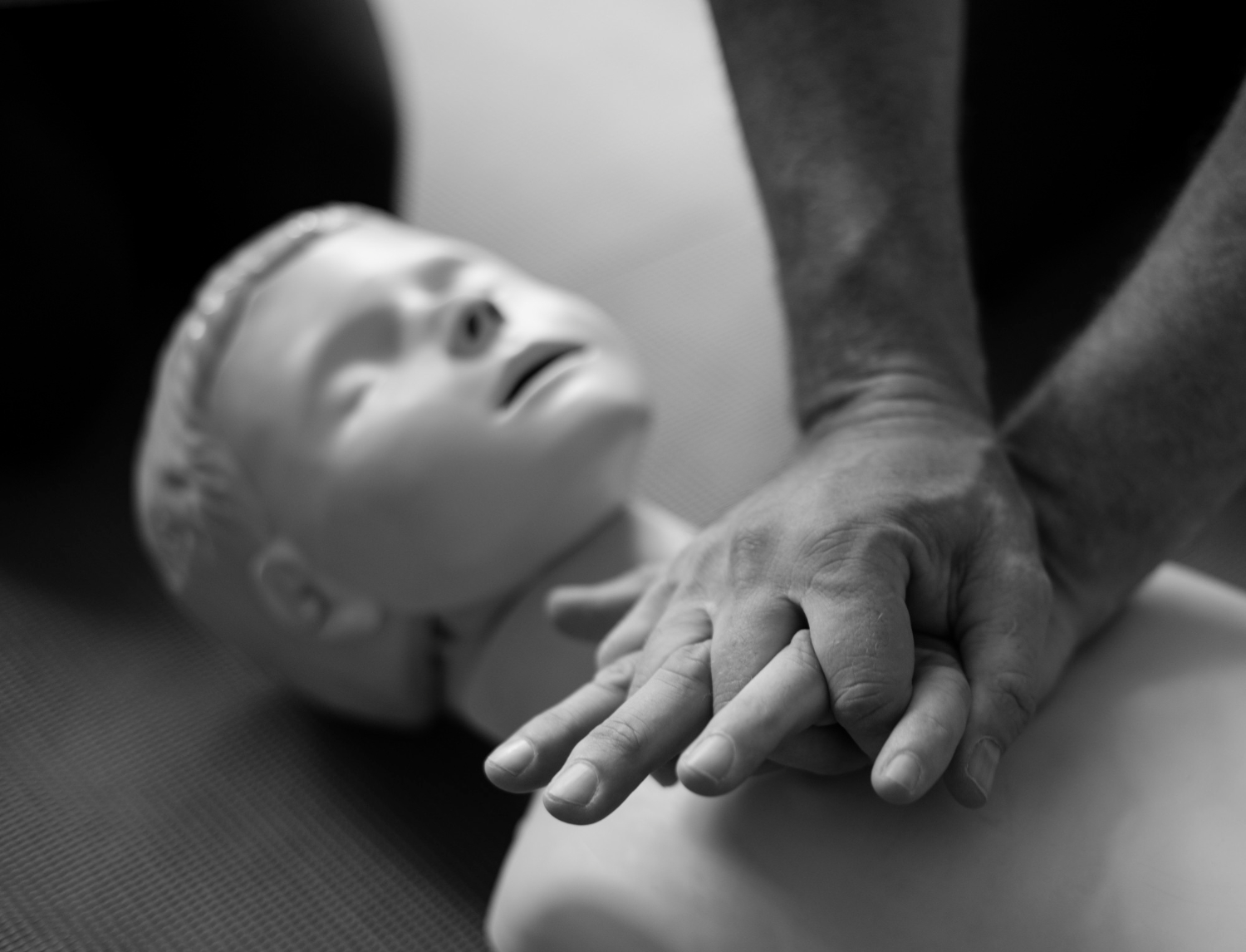
- Performing adult and infant CPR in accordance with Australian Resuscitation Council (ARC) guidelines including:
- managing the unconscious, breathing casualty including appropriate positioning to reduce the risk of airway compromise
- managing the unconscious, non-breathing adult and infant, including:
- performing at least 2 minutes of uninterrupted single rescuer cardiopulmonary resuscitation (CPR) (5 cycles of both compressions and ventilations) on an adult and infant resuscitation manikin placed on the floor
- operating and following the prompts of an automated external defibrillator (AED) to deliver at least one shock
- demonstrating a rotation of single rescuer operators with minimal interruptions to compressions
- responding appropriately in the event of regurgitation or vomiting
- handing over to emergency services
- providing an accurate verbal report of the incident
- reviewing the incident
- Applying advanced first aid procedures for casualties with the following:
- Allergic reaction/anaphylaxis
- Non-life-threatening bleeding such as nosebleeds, minor cuts, and scratches
- Choking and airway obstruction
- Envenomation using pressure immobilisation
- Fractures, dislocations, sprains and strains using pressure immobilisation
- Respiratory distress, including asthma
- Shock
- Communicating details of the incident
Entry Requirements
Participants must:
- Complete the designated online pre-course learning module(s) prior to attending the face-to-face training and assessment session
- The pre-course learning provides essential underpinning knowledge required for successful participation in classroom and practical activities
- Participants must have access to a computer, tablet, or smartphone with a stable internet connection to complete the pre-course online learning
- Basic computer literacy is required, including the ability to navigate online learning platforms and submit assessments electronically
- Students must perform uninterrupted CPR for at least 2 minutes on an infant manikin and adult manikin on the floor and use of an AED and apply appropriate first aid procedures.
- Provide photo I.D on entry
- Unless exempt, provide a verifiable USI number
- Be physically fit and healthy with capacity to perform manual tasks
- Be able to read, write, communicate orally, and understand and interpret complex information and situations
- Be able to interact with others and work under pressure
- Dress appropriately i.e., long sleeve, long pants or overalls, safety boots/closed in shoes, safety glasses
Please ensure you read our Student Handbook for further information on our policies, procedures, terms, and program conditions.
SDS is committed to identifying and supporting the language, literacy, numeracy and digital (LLND) needs of all learners. Where required, SDS may conduct an LLND assessment prior to training to determine whether any additional support or reasonable adjustment is needed.
Participants are encouraged to advise the training team at any time if they believe they may require learning support so appropriate arrangements can be made.
Delivery method
Self-Paced Online Learning
Participants will be required to undertake pre course learning and successfully complete an online multiple-choice assessment. This must be completed prior to attending the classroom session. The estimated time to complete the online component is approximately 2-4 hours.
Classroom Session
One (1) day consisting of practical training and assessment.
Assessments
Assessment includes written and/or multiple-choice knowledge assessment and practical based skills assessments.
Completion
On successful completion of all assessment requirements participants will receive a Nationally Recognised Statement of Attainment for:
- HLTAID011 Provide first aid
- HLTAID010 Provide basic emergency life support
- HLTAID009 Provide cardiopulmonary resuscitation
Skills maintenance
To ensure your skills and knowledge are maintained the Australian Resuscitation Council Guidelines recommend retraining in CPR at least annually.